
Pattern Caterpillar
Ages 2–6
A caterpillar game for spotting patterns
Spotting patterns is one of the first steps in logical thinking. When a child sees that red, blue, red, blue is followed by red, they are noticing a rule and using it to predict what comes next, a skill that underpins early math, reading and problem solving.
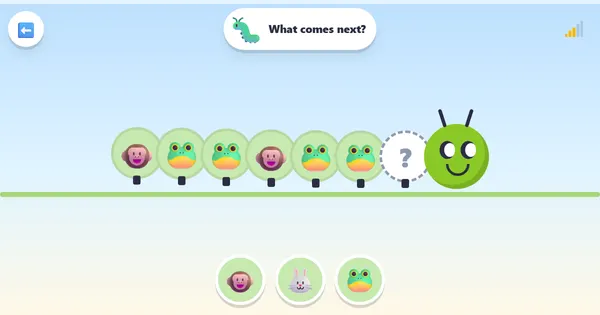
In our logic games, children finish the patterns on a friendly caterpillar: first two colors taking turns, then longer patterns with fruit and animals. Every instruction is spoken and shown, so children who can’t read yet can play on their own.
Ages 2–6
A caterpillar game for spotting patterns
Many children can continue a simple two-part pattern, like red, blue, red, blue, between 2 and 3 years old. Around 4, most can copy and continue longer patterns such as AAB or ABC, and by 5 or 6 many make up their own patterns and spot mistakes in them.
Patterns teach children to look for rules and use them to predict, which is the heart of logical thinking. They are an early math skill linked to counting, numbers and shapes, and spotting repeated sounds and letters also helps with reading.
Build patterns with blocks, beads, crayons or snacks and let your child continue them. Make sound patterns with claps and stomps, and point out patterns on clothes, wallpaper and tiles. Once your child is confident, let them make a pattern for you to continue.